

Quick Summary
- Ice dams on steep roofs aren’t just a snow problem — they’re a thermal mechanics problem driven by heat escaping your attic and refreezing at your eaves.
- The steep roof angles common in Hackettstown’s hilly neighborhoods accelerate this freeze-thaw cycle, putting extra stress on your fascia, gutters, and underlayment.
- DIY removal methods (hammers, rock salt, roof rakes) cause more damage than the ice itself — professional low-pressure steaming is the only safe, structure-preserving solution.
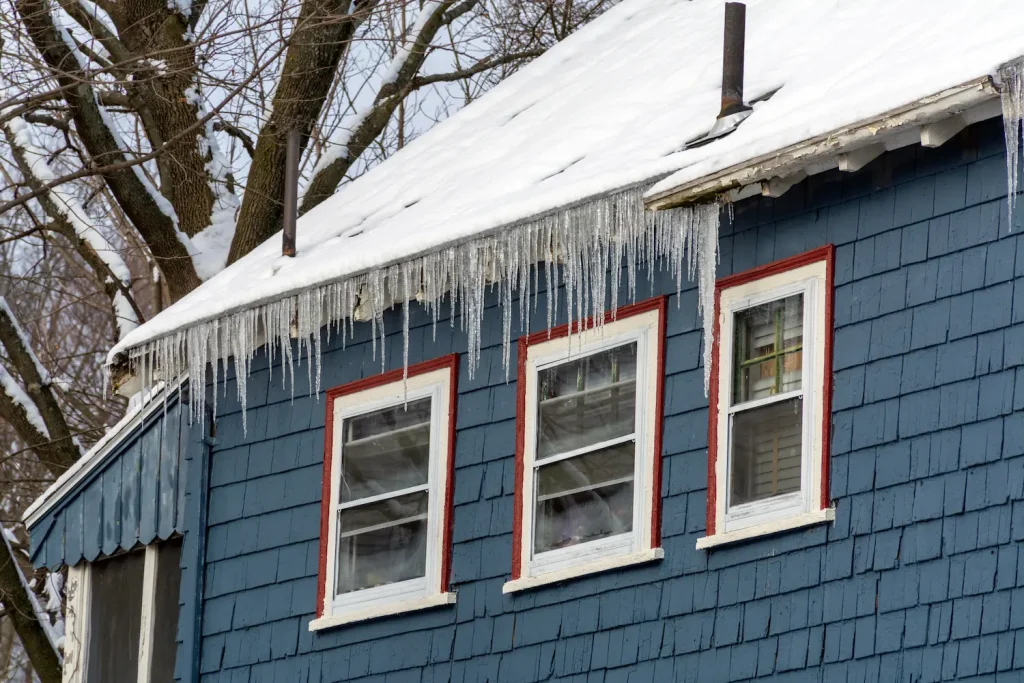
That row of thick icicles hanging off your eaves looks dramatic. But the real problem isn’t what you can see — it’s what’s happening underneath the ice, against your fascia board, and behind your shingles right now.
If your home sits on one of the hillside streets in Hackettstown — Mountain Avenue, the neighborhoods rolling toward Warren County, or anywhere with a steep-pitched roof — you’re dealing with a freeze-thaw dynamic that’s more aggressive than most homeowners realize. And the “fixes” most people reach for first? They often make things worse.
Let’s walk through what’s actually going on and how to protect your home the right way.
The Science Behind the Freeze-Thaw Cycle (It Starts in Your Attic)
Here’s the honest truth about ice dams: snow on your roof isn’t the cause. Heat escaping from inside your home is.
Think of your attic like a slow cooktop. If your insulation is inadequate or you have air leaks around chimneys, recessed lights, or attic hatches, warm air pools at the ridge of your roof. That warmth melts the snow on your upper roof surface. The meltwater runs down toward the eaves — which are cold because they extend past your home’s heated envelope — and refreezes into a solid wall of ice.
That wall is your ice dam. And every new melt cycle adds more water behind it.
Here’s what makes steep roofs in Northern NJ particularly vulnerable: the pitch angle combined with our region’s sun exposure accelerates the cycle. On a steep roof, direct winter sunlight hits the upper surface at a sharper angle, supercharging the daytime melt even when temperatures are below freezing. Then, when the sun drops, and temps swing back down overnight — which happens constantly in Warren County winters — that water flash-freezes at the eaves faster than it would on a shallower-pitched roof.
The result is a heavier, denser ice dam that builds up more quickly than you’d expect.
The Hidden Weight Your Fascia Is Carrying
Most homeowners focus on roof leaks when they think about ice dam damage. That’s a real risk — water backing up under shingles and soaking into your decking is serious. But there’s another threat that’s easy to overlook: the structural weight of the ice itself.
A mature ice dam on a steep roof can weigh hundreds of pounds. That load presses directly on your gutters, which transfer the stress to your fascia boards — the horizontal boards your gutters are mounted to. Fascia isn’t designed to carry that kind of sustained, downward load. Over time, you’ll see gutters pulling away from the roofline, sagging in the middle, or detaching entirely.
Once the fascia is compromised, you’re no longer just dealing with an ice problem. You’re looking at repairing weight-induced gutter sagging and potentially replacing rotted wood before any new gutter installation can happen.
This is why catching ice dams early — and treating them correctly — matters so much. A small problem in January becomes a full roofline repair by March.
Safe vs. Dangerous Ice Removal Methods
This is where we need to have a real conversation, because the internet is full of advice that will genuinely damage your home.
Methods to avoid:
- Hammers and chisels. Chipping at ice on a steep roof doesn’t just risk the ice — it risks your shingles, your underlayment, and your safety. One wrong strike removes the protective granules from your asphalt shingles, accelerating wear by years.
- Calcium chloride socks or rock salt. These work temporarily, but the chemical runoff is corrosive. Over multiple winters, it degrades asphalt shingles and eats through premium aluminum gutters from the inside out. You’re trading a short-term fix for long-term material failure. The hidden dangers of DIY ice removal go well beyond what most homeowners expect.
- Roof raking from a ladder on a steep pitch. This is a genuine safety hazard. Steep roofs are slippery, the angles are unforgiving, and ice can shift unpredictably. We’ve seen the aftermath of these falls. It’s not worth it.
The professional standard: low-pressure steam removal.
Steam is the only method that removes ice safely without damaging the roof surface underneath. A trained technician — using OSHA-compliant safety harnesses rated for steep-pitch work — can clear an ice dam thoroughly without touching a shingle. The ice melts cleanly, the water channels away, and your roof surface stays intact.
At Just Gutters, our team arrives with the right equipment for Hackettstown’s specific conditions: fully insured, harness-equipped, and experienced with the steep pitches and tight eave lines common to homes in this area. We don’t just remove the ice — we walk you through what caused it and what prevention looks like going forward.
The Long-Term Fix: An Inside-Out Prevention Strategy
Emergency removal solves today’s problem. Prevention solves next winter’s.
The most effective approach works from the inside out:
- Upgrade attic insulation. Bringing your R-value up to code (R-49 to R-60 for NJ climate zones) keeps heat from reaching the roof deck in the first place.
- Optimize your ventilation system. Proper soffit and ridge vents create continuous airflow that keeps the roof deck uniformly cold — no warm spots, no melt zones.
- Seal air leaks. Chimneys, plumbing stacks, recessed lights, and attic hatches are the most common culprits. Sealing these is cheap compared to avoiding emergency winter gutter repair costs after a dam has already formed.
- Install a proper ice and water shield. If your roof is due for replacement, insist on a self-adhering membrane that extends at least 24 inches past the interior wall line — not just to the eave edge. This is the code minimum for NJ, and it’s the last line of defense if a dam does form.
Next Steps
Ice dams on steep roofs aren’t an inevitable part of Northern NJ winters — they’re a symptom of a fixable problem. The freeze-thaw cycle that hammers homes in Hackettstown and across Warren County is predictable, which means it’s also preventable.
If you’re already seeing ice buildup at your eaves, don’t wait for the next warm spell to deal with it. That cycle of melt and refreeze is adding weight and water pressure to your roofline right now.
Your home’s gutters and fascia are in good hands with Just Gutters, LLC. Our family-owned team has been protecting Northern NJ homes through harsh winters for over a decade — with the top-quality materials, OSHA-compliant safety equipment, and honest, transparent service that our 275+ five-star Google reviews reflect.
Call or text us today for a FREE estimate: (201) 230-0381
Or request service online — we’ll get back to you fast, before the next freeze.
Frequently Asked Questions
Is it safer to mechanically remove an ice dam or use low-pressure steam on a steep incline?
Low-pressure steam is significantly safer and more effective on steep roofs. Mechanical removal (hammers, chisels, or pry tools) risks damaging shingles, removing protective granules, and puncturing the underlayment — especially on steep pitches where precision is harder to maintain. Steam melts the ice uniformly without any impact force, protecting both the roof surface and the technician performing the work.
What is the hidden cost of using calcium chloride socks on asphalt shingles over multiple winters?
Calcium chloride is corrosive over time. While it creates a melt channel through the ice dam, the chemical runoff degrades asphalt shingle granules season after season, shortening your roof’s lifespan. It also accelerates oxidation in aluminum gutters and can discolor or damage landscaping below the eaves. For a one-time ice event, it may seem harmless — but as a recurring winter habit, it’s an expensive shortcut.
Why do ice dams still form even after installing new soffit vents?
Soffit vents alone only solve half the equation. For proper cold-roof ventilation, you need both intake (soffit) and exhaust (ridge) vents working together to create continuous airflow across the roof deck. If the ridge vent is blocked, undersized, or absent, warm air still pools at the peak. Combine that with insufficient attic insulation or unaddressed air leaks, and ice dams will keep forming regardless of the soffit upgrade.
 A Comprehensive Gutter Cleaning Checklist: Clean Gutters and Downspouts Using Proper Safety Equipment